


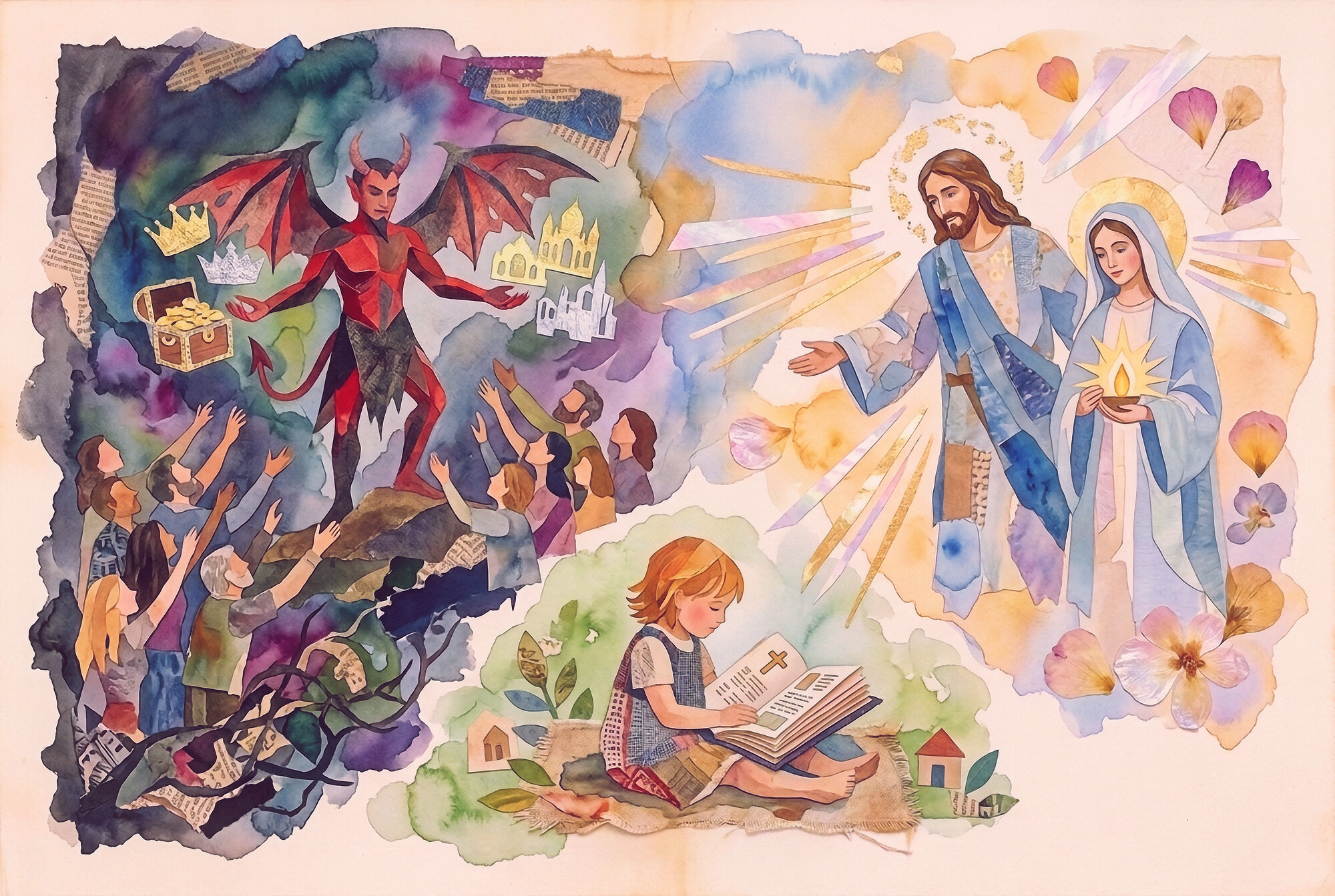
“Dear children! While darkness and peacelessness rule in many hearts, you, little children, be prayer and my extended hands of love. Little children, place the Sacred Scripture in a visible place in your family and read it, so that it may be an encouragement for you to conversion and a new life; because Satan is strong and seduces hearts. Your hearts, through my maternal Heart, I desire to commend to the Heart of my Son Jesus, so that He, the Risen One, may reign in you, and joy may begin to reign in you and around you. Thank you for having responded to my call.” -Our Lady of Medjugorje, in private revelation given to Marija Pavlovic-Lunetti, on July 25, 2026
An excerpt from “Thoughts for the Journey Home” by Marcus C. Grodi:
We can believe all the correct doctrines, even profess them with our lips. We can have the faith to move mountains, but as St. Paul emphasized in Romans 10:9-10, we must believe them in our hearts. Faith alone without a changed heart cannot save us.
Saying a quick prayer during an emotional moment at a crusade, camp meeting, or altar call can’t save anyone without a heart touched and changed by the Holy Spirit. With a changed heart, however, faith will lead to the recognition of the need for repentance and surrender of self to Christ; for forgiveness of self and others; for charity towards God and others; for prayer for self, others, and even enemies; for a constant increase of Christ and decrease of self; for a life of obedience, holiness, and growth in grace.
Any sincere evangelical Protestant knows this to be true, as witnessed by the thousands of sermons calling for changed hearts preached from pulpits all over America. But sometimes this truth is lost in theological debates.
We can also do all the kinds of good works and rituals expected of us by our Church. We can faithfully fulfill every rite of passage and regularly practice every sacrament and sacramental. We can staunchly defend every doctrine, dogma, or legislation of our Church, fighting even against those in our own Church who might desire to water down the requirements or the rubrics.
But without changed hearts, all of this is meaningless grandstanding. A Rosary said without a changed heart, without a heart in surrender to Christ, is just what Jesus warned about in Matthew 6 (verse 7)—an attempt to “babble like pagans, who think they will be heard because of their many words.” Again, any sincere Catholic knows this to be true, evidenced by the thousands of homilies calling for changed hearts preached from Catholic pulpits all over America.
An excerpt from “Inside the Bible: An Introduction to Each Book of the Bible” by Father Kenneth Baker, S.J.:
When you pass from reading the first three “synoptic” Gospels and come to John, you will will notice immediately that John is different from Matthew, Mark, and Luke. The story does not follow the same lines, and Jesus does not talk the same way He does in the other Gospels. Here we get a very different view of Him. It is a new world.
St. John’s Gospel is full of talks or discourses in which Jesus enters into a kind of dialogue with His audiences. There are frequent interruptions and questions from His adversaries; this does not happen in the synoptic Gospels.
There is no “Messianic secret” in John because in this Gospel the author stresses the divine transcendence of Jesus: He is the Word of God Who reveals His glory in His words and in His miracles, like changing water into wine at Cana, curing the man born blind, and raising Lazarus from the dead. In John, Jesus is presented as very aggressive in His preaching and whole manner of life.
The main themes or topics are also different. [Jesus] rarely mentions the Kingdom of God (twice). Instead He speaks of life and eternal life; love, truth, and light; He refers to Himself in the “I am” formula fifty-four times; He speaks of bearing witness, judging, dwelling; He talks about the world often, about Jews, and He speaks of God as Father 118 times.
John is not intensely interested in eschatology, that is, the question of the end of the world and the Second Coming of Christ. The focus is more on Jesus being present and active in His Church right now; for John, the end of the history of the world is already basically attained in the resurrected Christ, Who has triumphed over Satan, sin, and death. Those who believe in Him share in that victory in a spiritual way now.
John emphasizes the divinity and glory of Jesus. He sees through external appearances to the reality that is hidden in Christ Jesus, the Son of God and Savior of the world.
The Gospel is also sacramental in its approach, that is, there are many subtle references to the sacraments: the water changed into wine points to the Eucharist; the discussion with Nicodemus is about the necessity of Baptism; the water and blood flowing from the pierced side of Jesus on the Cross symbolize Baptism and the Eucharist; after His Resurrection, Jesus gives His apostles the power to forgive sins (the Sacrament of Reconciliation).
The Gospel of St. John is a treasure hidden just under the surface. The deeper you dig, the more treasure you find. The book is full of symbolism—Jesus is the source of light and life and truth.
The true light that enlightens every man was coming into the world. He was in the world, and the world was made through Him, yet the world knew Him not. He came to His own home, and His own people received Him not. But to all who received Him, who believed in His Name, He gave power to become children of God; who were born, not of blood nor of the will of the flesh nor of the will of man, but of God. And the Word became flesh and dwelt among us, full of grace and truth; we have beheld His glory, glory as of the only-begotten Son from the Father. (John bore witness to Him, and cried, “This was He of Whom I said, ‘He Who comes after me ranks before me, for He was before me.’ “) And from His fullness have we all received, grace upon grace. For the law was given through Moses; grace and truth came through Jesus Christ. No one has ever seen God; the only-begotten Son, Who is in the bosom of the Father, He has made Him known. (John 1:9-18)
