


“Dear children, rejoice with me, because the Most High permits me to be with you, to lead you to Him Who is the Way, the Truth, and the Life. Rejoice, little children, and be joyful also in difficulties, and you will have the strength, because you will be aware that you are transient and you will know to offer everything to God. That is why, do not forget: I am your Mother and I love you. Thank you for having responded to my call.” -Our Lady of Medjugorje, in private revelation given to Marija Pavlovic-Lunetti, on June 25, 2026
An excerpt from “The Soul of the Apostolate” by Jean-Baptiste Chautard:
“Without Me you can do nothing.” (see John 15:5) This is the principle. The Blood that redeemed us was shed on Calvary. How was God going to insure its fruitfulness at the very start? By a miracle of the diffusion of interior life. There was nothing more paltry than the ideals and the zeal of the apostles before Pentecost. But once the Holy Spirit had transformed them into men of prayer, their preaching began at once to work wonders.
But God does not, in the ordinary course of things, repeat the miracle of the Upper Room. His way is to leave the graces for our sanctification to fight it out with the free and arduous correspondence of His creature. But in making Pentecost the official birthday of the Church, did He not give us a clear enough indication that His ministers would have to make the first step, in their work as co-redeemers, the sanctification of their own souls?
Therefore, all true apostolic workers expect much more from their sacrifices and prayers than from their active work. Father Lacordaire spent a long time in prayer before ascending the steps of the pulpit, and on his return he had himself scourged. Father Monsabré, before speaking at Notre Dame, used to say all fifteen decades of the Rosary on his knees. “I am taking my last dose of tonic,” he said with a smile to a friend who questioned him about this practice. Both these religious lived according to St. Bonaventure’s principle, that the secret of a fruitful apostolate is to be found much more at the foot of the Cross than in the display of brilliance.
“These three remain: word, example, prayer; but the greatest of these is prayer,” cries St. Bernard. A very strong statement, but it is simply a commentary on the resolution taken by the Apostles to leave certain works alone in order to give themselves first of all to prayer, orationi; and only after that to preaching, ministerio verbi.
Have we not often enough pointed out, in this connection, what a fundamental importance the Savior gave to this spirit of prayer? Looking out upon the world and upon the ages that were to come, He cried out in sorrow: “The harvest indeed is great, but the laborers are few” (see Matthew 9:37-38). What would He propose as the quickest way to spread His teaching? Would He ask His apostles to go to school in Athens, or to study, at Rome, under the Caesars, how to conquer and govern empires? You men of active zeal listen to the Master. He reveals a program and a principle full of light: “Pray ye therefore the Lord of the harvest that He send forth laborers into the harvest.” No mention of techniques of organization, of raising funds, building churches, or putting up schools. Only “pray ye”—Rogate. This one fundamental truth of prayer, and the spirit of prayer, is something the Master constantly repeated. Everything else, without exception, flows from it.
“Pray ye therefore!” If the faint murmur of supplication from a holy soul has more power to raise up legions of apostles than the eloquent voice of a recruiter of vocations, who has less of the spirit of God, what are we to conclude? Simply that the spirit of prayer, which goes hand in hand, in the true apostle, with zeal, will be the chief reason for the fruitfulness of his work.
“Pray ye therefore!” First of all, pray. Only after that, does our Lord add “going, teach… preach….” (see Matthew 10:7) Of course, God will make use of this other means; but the blessings that make a ministry fruitful are reserved for the prayers of a man of interior life. Such prayer will have the power to bring forth from the bosom of God the strength for an apostolate that souls cannot resist.
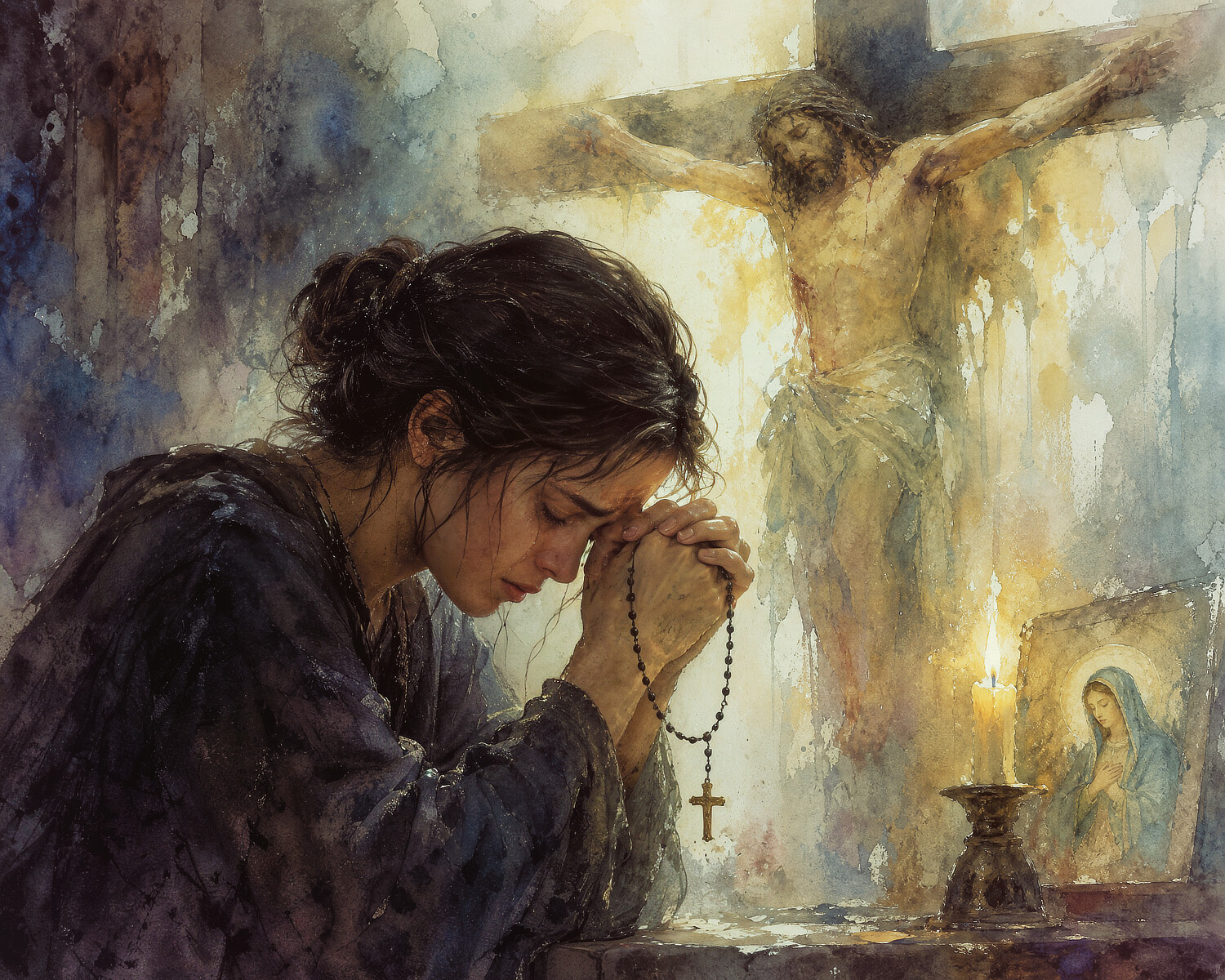
“Dear children! My motherly heart suffers tremendously as I look at my children who persistently put what is human before what is of God, at my children who, despite everything that surrounds them and despite all the signs that are sent to them, think that they can walk without my Son. They cannot! They are walking to eternal perdition. That is why I am gathering you, who are ready to open your heart to me, you who are ready to be apostles of my love, to help me; so that by living God’s love you may be an example to those who do not know it. May fasting and prayer give you strength in that, and I bless you with my motherly blessing in the Name of the Father, and of the Son, and of the Holy Spirit. Thank you.” -Our Lady of Medjugorje, in private revelation given to Mirjana Dragicevic-Soldo, on March 2, 2011
An excerpt from “Seeking the Heart of Christ: Christian Reflections on the Interior Life” by Saint Claude La Colombière:
I am astonished that it takes so much pain to be persuaded that one can be happy in adversity, seeing how one has seen so many miserable persons in the greatest prosperity. If there are invisible evils, is it impossible that there are secret sweetnesses?
When God sends us crosses, He does it through the same principle of charity through which He willed that His only-begotten Son be crucified for us. “We are members of Jesus Christ, from which it follows,” says Saint Augustine, “that, as all that He endured on the day of His Passion and His death, we have endured in His Person, so, now, all that we suffer, He Himself suffers in our persons.”
Jesus Christ is the witness, the companion, and the author of our sufferings. He sees the evil that you suffer, He suffers the evil that you suffer, He makes the evil that you suffer. If we were enlightened enough to see our true advantages, we would ask for adversity…. That father who sees his son’s skull open suffers more than him, and thus, one must not believe that if it were not really useful to him, he would permit it….
Adversity is even necessary for the good in order to preserve them from corruption, like salt which consumes and preserves. This is a sign that God loves you and that He wants to be loved by you; He is jealous.
